
by Colin J. Piper – – –
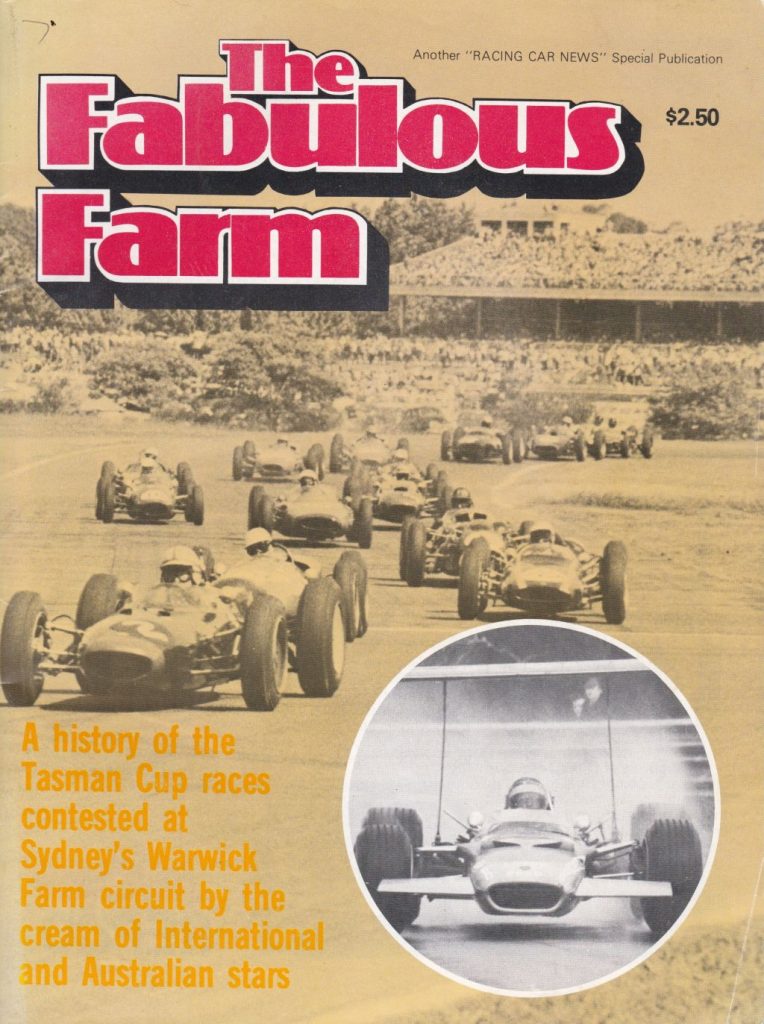
Enter the name Hugh Griffiths into the AMHF Archive Database and you will be directed to one book in our collection: “The Fabulous Farm: Tasman Cup Races,” published by Racing Car News in 1979 and sold for the princely sum of $2.50. It is in magazine format, the same style as RCN. Type the name Hugh Griffiths into Google however, and you will produce nothing relating to this gentleman whom I first met in the late 1960s. He was introduced to me by Mary Packard. Mary of course is someone who needs no introduction to anyone in any way associated with Warwick Farm or the AARC throughout its history. She appears in the Australian Dictionary of Biography where her contributions to motor racing and flying are recorded.
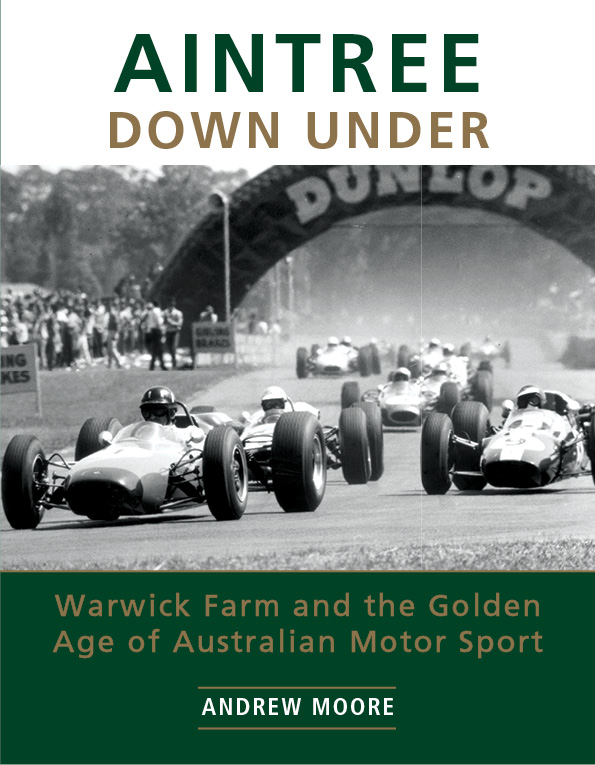
Should one enter Warwick Farm into the searchable database, you will be directed to Andrew Moore’s excellent “Aintree Downunder” and two Race Programmes. Hugh’s book does not yet appear in this result, but it will soon.
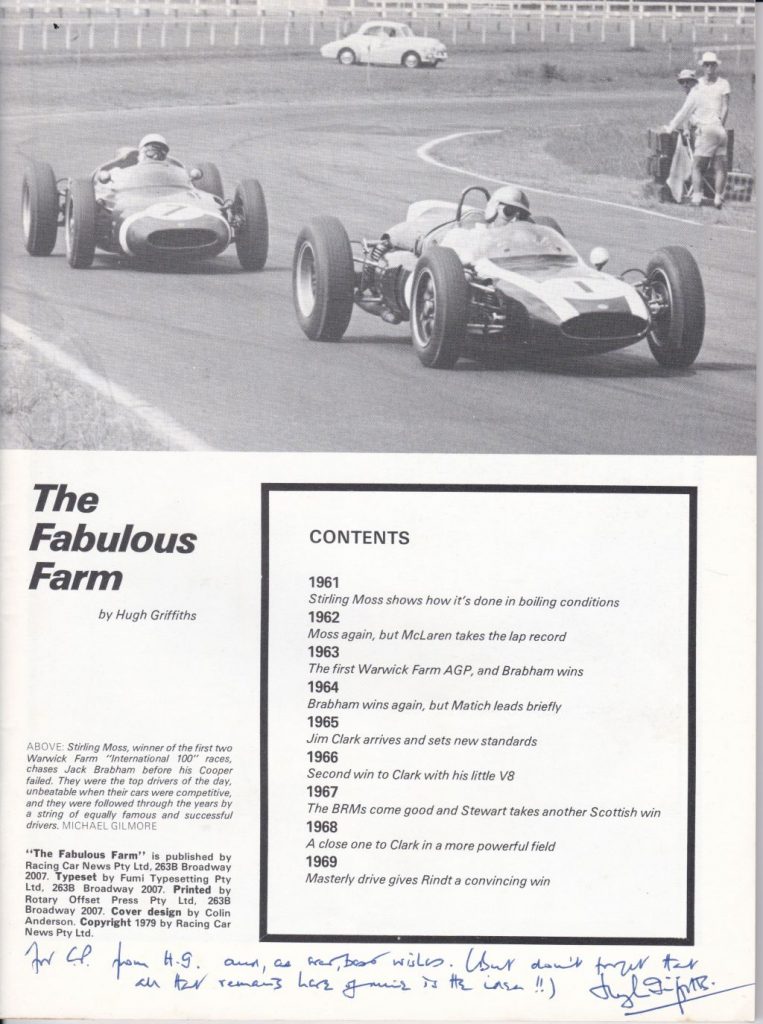
The book Hugh wrote details the Warwick Farm International 100s held between 1961 and 1969 including two Australian Grand Prix (1963 and 1967). The races from 1964 onwards were part of the Tasman Cup for 2.5 litre cars which took place in New Zealand and Australia in the European off season. It was a time when the greatest Formula One drivers of the era came here.
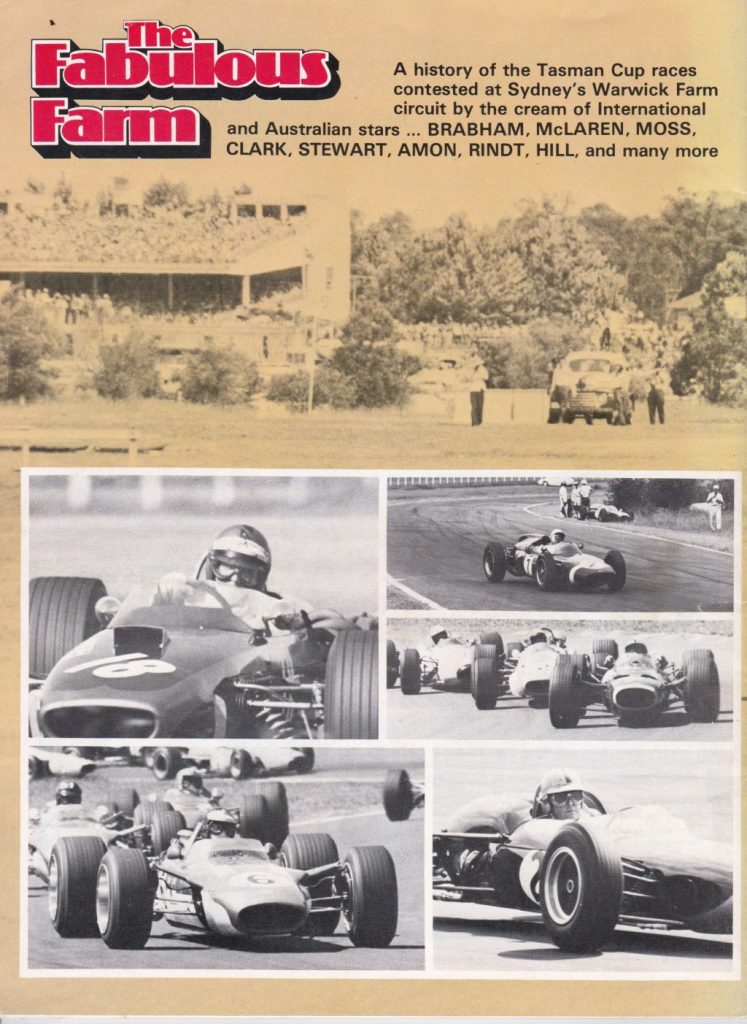
Hugh authored the story of those nine races, and his book includes many excellent black & white photographs. I think I am correct in saying that it was the first time those Warwick Farm events were covered in the one publication. Hugh was never a fan of the F5000 era, which commenced in 1970 in Australia, hence his concentration on the 2.5 litre era. The F5000 Tasman races were held at the Farm until 1973, but sadly the circuit ceased operating later that year, though the Tasman Cup continued until 1975.
Hugh was a true motor racing enthusiast, and particularly keen on open-wheeler racing cars. One might say he was a purist.
He was a grid marshal at Warwick Farm for the 1961 International 100, won by Stirling Moss in oppressive heat and again at the 1969 race, won by Jochen Rindt in appallingly wet conditions. This was about the time I met him. Indeed, throughout the 1960s Hugh had been a regular official at Warwick Farm.
I should add that the role of grid marshal was one of the plum jobs at the Farm and one which was highly sought after.
Discovering much about ‘HG’ as I used to call him has not been easy. Considerable research by my wife Jan has led us to believe that he was born in 1939 in the UK and came to Australia in 1946 with his parents and three siblings and settling in Adelaide. I have not been able to determine when he came to Sydney.
My connection with Hugh began when I was a newly appointed member of the Sydney Symphony Orchestra in the late 1960s. Mary Packard, who was a long-time SSO subscriber, asked me if I had met him. Turns out, he was the Artist Escort, casually employed by the ABC (which at the time ran all the Australian State Orchestras) to travel in hire cars with visiting conductors and soloists from their various hotels to and from the Sydney Town Hall then from late 1973 onwards, the Sydney Opera House. Always impeccably dressed in a dinner suit, he carried the musicians’ concert clothes and music as required and made sure they were well settled into their respective dressing rooms and so on. I am sure his quiet demeanour and reassuring presence was appreciated by them all. The very fact that the ABC engaged Hugh in this role for so long would indicate that he was highly thought of by all concerned. This he did after his day job, in the book/publishing industry, I think for Oxford University Press and/or their associated Australian agents, which might have been Penguin Random House at the time.
I know Hugh was involved with the promotional visit of Roald Dahl to Australia in 1989. HG gave our daughters several children’s books when they were very young. He also gave me some excellent music books from the OUP publication list.
Hugh and I became good friends following the closure of Warwick Farm. At the AARC Club Meetings held at Amaroo Park we filled many varied roles in tandem, helping with timekeeping under the watchful gaze of Kevin Hutchison and we were judges of fact on many occasions. Best job of all was attending to the functions as starter and then occasionally, chequered flag duties. The latter was always in the manner prescribed by Geoff Sykes and Charles Brittlebank in the ‘Farm’ era… waved for the winner then held still for the rest of the field. We took it in turns to start the races. It was my favourite job! On the small scaffolding opposite the tower at Amaroo, 30 second board, then at 10 seconds, (flag horizontal), 5 seconds, vertical (and VERY still)… eyes fixed on a stopwatch then lowering quickly to start the race. So much more evocative than the dreaded red/green lights of today. I have always marvelled at the antics of some of the starting procedures in the 1950s and 1960s in European racing. Someone like Raymond ‘Toto’ Roche would literally stand in the middle or edge of the track, vaguely brandish the French tricolour and then run for his life as the field bore down on him. Roche appeared to have no concern whatsoever for his wellbeing. I read that once he got the flags mixed up and used the red flag instead. I can only imagine what the drivers on the front row were thinking at that very moment! That said, he, in common with other officials of the period, survived. Some of these antics can be found on YouTube.
With the last AARC Club Meeting in November 1986 and the Sydney Symphony Orchestra at around the same time becoming independent from the ABC, I saw much less of Hugh in subsequent years, though we did exchange Christmas Cards and had the occasional phone call and catch up.
Those AARC Club Meetings at Amaroo Park were such pleasant days surrounded by the sights, smells and sounds of true Club Motorsport. HG and I basically did whatever Mary Packard asked us to do, filling any gaps as required, and loving every minute of it.
The photo, with Sir Jack Brabham and Mary Packard, was taken on December 18th, 1994 at the Royal Automobile Club of Australia, an occasion organised to honour Mary. She had been recently diagnosed with cancer and sadly was to die only 11 months later. We do know that Hugh died in 2000, as there is an obituary notice in the SMH on August 2nd of that year.
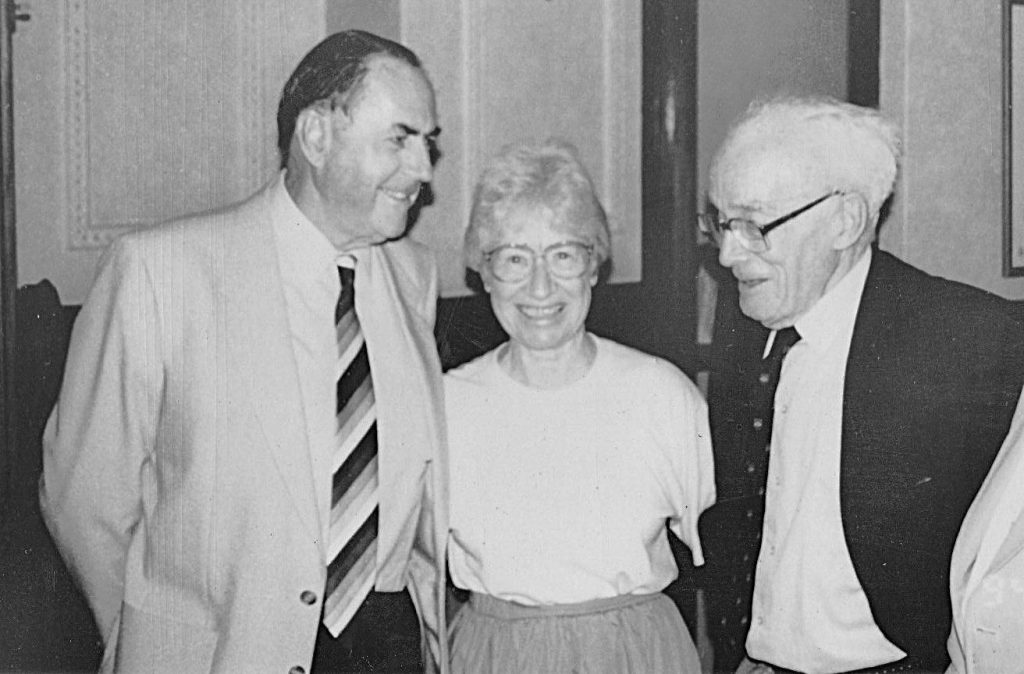
I hope by putting this small piece together, this mysterious and hitherto invisible author whose name crops up in the AMHF database might emerge from obscurity. He was a true enthusiast, a thorough gentleman in the Geoff Sykes manner (they were good friends), and wonderful company. All these years later I wish now I had known him better. He house-sat for us in Carlingford for a month in 1980 when we went to Adelaide for Christmas… though he did neglect to water the pot plants!
