
by Brian Goulding – – –
Back on September 22, 1975, the 1976 Tyrrell Formula One car was introduced to the world’s press. The new car sat in the London Airport Heathrow Hotel under a white dust sheet with all the familiar bumps showing – rear wing, cockpit roll hoop and front wheels. However, when the P34 was revealed, there was an awkward moment of stunned silence.
The bulges that looked like they covered the front wheels and tyres turned out to be two lumps of wood resting on four small wheels – two on each side – at the front of the car.
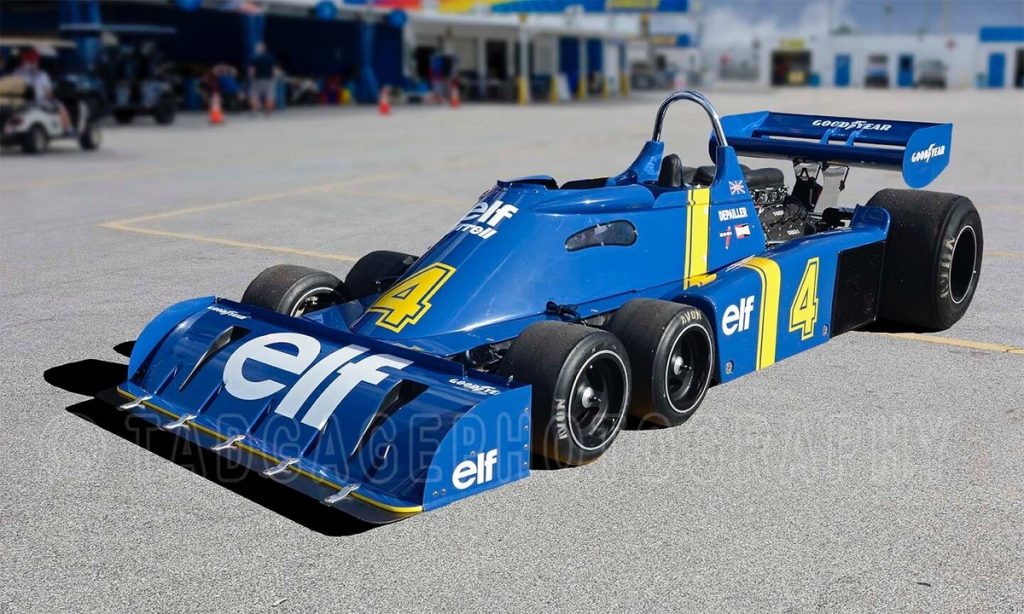
It was left to Derek Gardner, the car’s designer, to break the silence by highlighting the theoretical advantages of his radical six-wheel design.
Firstly, the car should be faster in a straight line because the four small front wheels were mounted close to the chassis tub and behind the full-width front air dam/spoiler. This produced a smaller frontal area, while the turbulence generated by the front wheels was kept to a minimum to cut down drag.
Braking should be improved because of the increased tyre contact at the front end.
The car should be at least as good as other cars through the corners.
He also highlighted the real safety advantage of a front-end puncture no longer being a crisis for the driver.
Within hours of the press conference the P34 was news around the world but also an instant focus of jokes and cartoons. If the Tyrrell Team used the six-wheeler to gain publicity, it had certainly worked. Some experts, who should have known better, dismissed the design outright. Of course, it was performance on the track that would prove or disprove Gardner’s innovative design.
For 1976, Ken Tyrell contracted South African Jody Scheckter and Frenchman Patrick Depailler as drivers for the Formula One season. The pair used the proven 007 Tyrrell cars for the first three flyaway races in Brazil, South Africa and USA West.
The Spanish GP was the first European race of 1976, so Team Tyrrell decided to enter Scheckter in a 007 and Depailler in the debut of the P34. Depailler surprised by scoring third grid spot. Sadly, an accident on lap 25 put the P34 out.
The next race was the Belgian GP and two P34s appeared on the grid. Scheckter scored a fine fourth while Depailler failed to finish because of engine problems.
The prestigious Monaco GP was up next, and like today, this was the most glamorous GP on the calendar. The team was overjoyed with fine second and third places, behind Laudi’s Ferrari, in front of all that royalty and glitterati.
Now the P34 had real credibility. Next up was the Swedish GP at the unusual Anderstorp circuit. It was unusual because all of the corners were a constant radius, like a Scalextric track on a bedroom floor, and the layout was simple. It must have suited the Tyrrells perfectly because in only the fourth race of the P34 the team scored a resounding first and second.
The strong results continued for the rest of 1976. There were no more wins, but Tyrrell drivers scored six podiums in the remaining nine Grands Prix. Scheckter was second at the British GP, second at the German GP and second at the US East GP. Depailler sprayed the champagne with a second at the French GP, second at the Canadian GP and another second at the season-ending Japanese GP. This race may be familiar because it was the first ever grand prix telecast live in Australia. The weather was so bad that Niki Lauda, still recovering from his near-fatal Nurburgring crash, drove into the pits and retired on lap two, Hunt winning the championship.
But I digress.
It had been a great championship year for Elf Team Tyrell. Scheckter had finished third in the Drivers’ World Championship with 49 points and Depailler fourth on 39. In the constructors’ title Ferrari won on 83 points with McLaren second on 74 and Tyrrell close in third on 71. The 007 Tyrrell had only contributed 13 of these points.
So things looked rosy for 1977. Scheckter moved on to the new Wolf team and was replaced by Ronnie Peterson. An additional sponsor came on board so the team name changed to Elf FNCB Tyrrell in deference to First National City Bank. Also, the colour scheme on the cars changed to a white top half and mid blue bottom half (FNCB colours) while a more streamlined bodywork covered the engine as well.
Compared to 1976, the 1977 year was a disaster. It was all about reliability or rather lack of reliability. Of the 17 races contested in 1977 by the two Tyrrell drivers, only three podiums were achieved – a second and two thirds to Depailler. Peterson failed to finish 10 times and Depailler nine. At five Grands Prix both cars failed to finish. Depailler finished an ordinary equal eighth in the drivers’ championship, Peterson a miserable 14th. When both drivers’ points were added together the team finished an ordinary equal fifth with Brabham in the Constructors’ Championship.
From the P34’s launch, its four small front wheels and tyres were a topic of great discussion. Because of their smaller diameter and the increased revolutions that resulted, there was extra strain placed on the front tyres. Also, there was a smaller surface area for dissipating heat. For 1976 new tyres were developed by Goodyear, the sole Formula One tyre supplier.
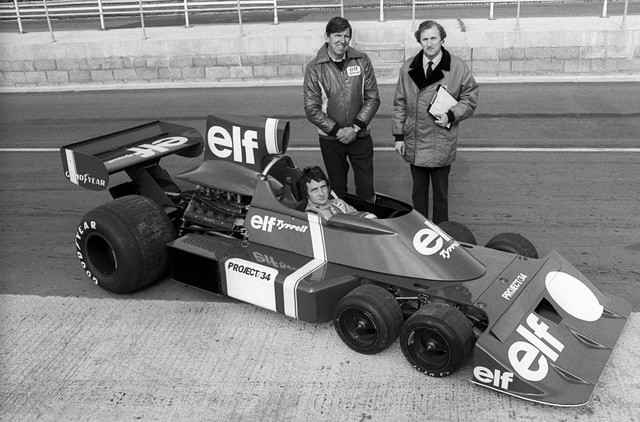
During the 1977 season rumours circulated that part of the reason for the lack of results was the slowdown in tyre development by Goodyear. Because the 10-inch tyres were only used by one team, the development of new constructions and compounds was not economically efficient. In reality, however, the terrible reliability record of both cars, as detailed previously, was probably the reason.
The six-wheel concept appeared to be successful in 1976, yet nobody else really gave it a go. March Engineering built a six-wheeler by grafting four small rear wheels to a 761 chassis in 1977, but it encountered major differential problems and was soon banished to the British Hillclimb Championship. Williams also tried four small rear wheels, but the car was also a developmental dead end. And that was it… six wheels were gone.
